Most wiring sits behind walls and ceilings, so problems rarely announce themselves until something goes wrong. The good news is that ageing or faulty wiring often leaves clues first: a smell, a sound, a switch that behaves oddly, or a safety switch that trips for no obvious reason.
This guide covers the signs worth noticing, what usually causes them and when to call a licensed electrician. It also explains which checks are safe for you to do and which are not.
The short answer
Old or faulty wiring commonly shows up as:
- frequently tripping safety switches or circuit breakers
- burning smells or scorch marks
- warm or discoloured power points and switches
- buzzing, crackling or sizzling sounds
- flickering or dimming lights
- cracked, brittle or damaged cable insulation (where it’s visible)
- two-pin power points, ceramic fuses or no safety switches
Any of these is a reason to book a licensed electrician. A burning smell, smoke or visible sparking is an emergency. Switch off at the main switch if it’s safe to reach, leave the area and call 000 if there’s fire or smoke.
Why wiring ages
Wiring doesn’t last forever, and the insulation matters most. Insulation keeps live conductors from touching anything they shouldn’t. As it degrades from age, heat, overloading, vermin or sunlight, the risk of shocks and fires rises.
Age is a useful guide to what you might have:
- Homes wired before about 1960: These are likely to contain VIR (vulcanised Indian rubber) or TRS (tough rubber sheathed) cable. Queensland’s electrical safety regulator notes that installations from this era are likely to contain this insulation, which is now nearing the end of its service life. The Queensland Building and Construction Commission adds that it may have deteriorated to the point of exposing live conductors.
- Mid-century to 1980s homes: These often have PVC-insulated cable, which generally lasts longer. The switchboard and circuit layout may still be outdated, though. Many older boards have few circuits and no safety switches.
- Newer homes: Wiring is usually in better condition, but poor workmanship and faulty products can still cause problems. In one Australian example, the ACCC recalled “Infinity” cable installed around 2010–2013 after tests found its plastic insulation degraded prematurely and could expose live conductors if disturbed.
Age alone doesn’t prove the wiring is faulty, and a newer home isn’t automatically safe. Only testing by a licensed electrician can tell you the condition of the wiring.
Warning signs you can notice yourself
1. Safety switches or breakers that keep tripping
A single trip after a storm or a faulty appliance isn’t necessarily alarming. Repeated tripping, especially when no appliance explains it, can point to deteriorating insulation, moisture in the wiring or an overloaded circuit.
What to do: Unplug appliances on the affected circuit and see whether the trips stop. If the problem persists, stop resetting it repeatedly and call an electrician. Repeated resetting hides a fault that is trying to protect you.
2. A burning or fishy smell
Overheating insulation, loose connections and arcing can all produce an acrid, plastic-like or fishy smell. Treat it as urgent, even if it fades.
What to do: Switch off the circuit or the main switch if it’s safe to do so, keep clear of the area and call an electrician. Call 000 if you see smoke or flames.
3. Warm, discoloured or crackling power points and switches
A power point that’s warm to the touch, or has brown or black discolouration around it, can indicate a loose connection or an overloaded circuit. Crackling or buzzing sounds can mean arcing, where electricity jumps across a gap.
What to do: Stop using that outlet and have it inspected. Don’t remove the faceplate to look inside.
4. Flickering or dimming lights
Lights that flicker or dim when a heavy appliance starts may point to an overloaded circuit or a loose connection. Occasional flicker can also come from a failing globe or a network supply issue, so look for patterns. If it happens across several rooms or comes with other signs on this list, get it checked.
5. Outdated fittings in the home
Some older features suggest a system that predates current safety expectations:
- two-pin power points (no earth connection)
- ceramic fuses in the switchboard
- cracked or brittle fittings
- a switchboard with no safety switches
- extension boards and double adaptors used permanently because there are too few power points
Queensland’s regulator has also warned about cracked and brittle bakelite fittings and deteriorated wiring in older installations. These items don’t prove the wiring is faulty, but they’re good reasons to book an assessment.
6. Visible damage to cables
You might spot cables in a roof space, garage or under a house with cracked, crumbly or chewed insulation. Don’t touch them or disturb them. Older insulation can be fragile, and disturbed cables can expose live conductors. Note where you saw them and tell your electrician.
Signs that need a professional to test
Some problems can’t be seen, even by experienced eyes:
- Insulation resistance testing shows how well the insulation is holding up across the circuit.
- Earth continuity and earth fault loop testing checks that the earthing system will operate as intended when a fault occurs.
- Safety switch testing confirms the device trips within the required time.
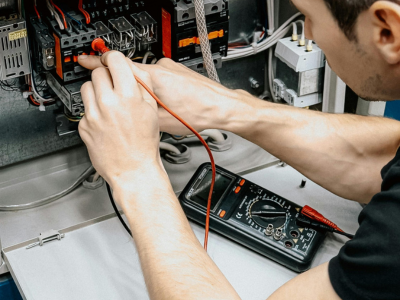
A licensed electrician uses specialised test equipment for this work. It isn’t a DIY job, and it’s why a “looks fine” inspection by an owner doesn’t replace a proper electrical safety check.
What not to do
- Don’t open switchboards, power points or light fittings to investigate.
- Don’t tape over or bypass a tripping safety switch or breaker.
- Don’t replace a circuit breaker with a higher-rated one to stop it tripping.
- Don’t overload power boards to get around too few outlets.
- Don’t assume that because the lights work, the wiring is safe.
Common misconceptions
“If it hasn’t caused a problem in 50 years, it’s fine.” Insulation keeps ageing, and loads have changed. Today’s homes run far more electronics, air conditioners and heating than the circuits were designed for.
“A new switchboard fixes the wiring.” An upgraded switchboard with safety switches adds important protection, but it doesn’t repair brittle cable further down the circuit.
“Rewiring means ripping out all the walls.” Not always. The scope depends on the condition of the wiring and the layout of the home. An electrician can explain whether a partial or full rewire makes sense after inspecting.
What a licensed electrician will check
A typical electrical safety inspection may include:
- The type and condition of the visible wiring (roof space, subfloor, switchboard).
- Switchboard condition, circuit breakers, fuses and safety switches.
- Testing for insulation resistance and earthing.
- Power points, switches and light fittings for heat damage or wear.
- Whether the wiring suits current electrical loads.
- Recommendations: repairs, a switchboard upgrade, partial rewiring or a full rewire.
Rewiring costs depend on the size of the home, how accessible the cabling is, the number of circuits, the switchboard and any make-good work. A written quote after an on-site assessment is more reliable than a generic figure.
Buying or renovating an older home?
Ask for an electrical inspection before you commit. Hidden wiring issues can add significant cost, and renovations that open walls and ceilings are a good time to deal with them. If you’re a landlord, check the electrical safety requirements for rental properties in your state or territory, as they differ.
Frequently Asked Questions
How long does house wiring last?
Can old wiring cause a fire?
Is it safe to keep living in a house with old wiring?
Does a tripping safety switch always mean faulty wiring?
How do I know if I need a rewire?
Do I need an electrician if I'm buying an older home?

admin
Beattie Electrical — trusted Sydney electricians.