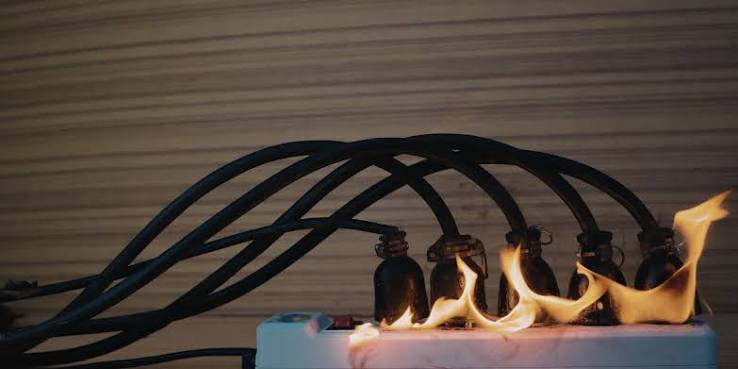
A burning smell near a power point or switchboard is a warning that something may be overheating. It can happen before there is any visible smoke or flame, which is why it is easy to dismiss and unwise to ignore.
This guide covers what to do in the first few minutes, when to call 000, what usually causes the smell, and what a licensed electrician does about it.
The short answer: what to do right now
- If you see flames, smoke, sparks or melting, leave the area and call 000. Don’t try to deal with it yourself.
- If there is no sign of fire, stop using the affected power point or circuit. Don’t touch it if it looks scorched or feels hot.
- If it is safe, switch off the relevant circuit at the switchboard. Only do this if the board is dry, undamaged and not smoking, scorched or hot.
- Keep people and pets away from the area.
- Call a licensed electrician the same day. Treat it as urgent even if the smell fades.
Government guidance supports this approach. Victoria’s building authority advises that if you notice buzzing from power points, flickering lights or circuits that keep tripping, you should disable services at the switchboard and contact your electrician or Energy Safe Victoria (ESV) for advice. ESV also lists burning smells among the warning signs to watch for in electrical systems.
Why a burning smell is taken so seriously
Electricity doesn’t normally produce a smell. When you can smell something hot, plastic, rubber or wiring insulation is usually being heated more than it should be.
Common causes include:
- Loose connections. A loose wire at a power point, switch or breaker creates resistance. Resistance produces heat, and heat damages the surrounding plastic and insulation.
- Overloaded circuits or power boards. Heating appliances such as heaters, kettles and toasters draw a lot of current. Plugging several into one outlet or power board can overheat it. NSW health guidance warns against stacking plugs or piggy-backing double adaptors, because this can overload the power point and cause a fire.
- Damaged or ageing wiring. Older insulation can become brittle or degrade with heat over time.
- A faulty appliance or plug. The smell can come from the appliance or its cord rather than the wall. Heat marks on a plug pin are a clue.
- A failing circuit breaker or switchboard component. Switchboards carry the full current for each circuit, so a worn or loose connection there can overheat.
- Arcing. This is a small electrical discharge across a gap, often from a loose or damaged connection. It can be accompanied by buzzing or crackling.
Power point versus switchboard
A power point smell is usually limited to one circuit. You can often isolate it by switching off that circuit.
A switchboard smell is more serious. The board is where the whole house’s power is distributed, and it contains live parts. If the board itself is the source, don’t open it, probe it or try to find the fault. Heat, discolouration or smoke at the board means you should keep your distance and call for help.
When to call an electrician urgently
If there is no fire but you notice any of these, call a licensed electrician promptly:
- A burning smell near a power point, switch or switchboard, even if brief
- A power point or plug that feels warm or hot
- Discolouration or browning around a socket or switch plate
- Buzzing, crackling or sizzling sounds
- A circuit that keeps tripping or a safety switch that won’t reset
- A smell you can’t trace to a source
A slight warmth after a heater has run for hours can be normal. Heat that persists, or any smell, is not.
Could it be something harmless?
Sometimes. A new appliance can give off a short-lived smell on first use, and a heater can smell of burnt dust the first time it runs in a season. A burning smell can also come from non-electrical sources.
The sensible rule: if you can’t confidently identify a harmless source, treat it as an electrical fault until a licensed electrician says otherwise. Unplug the suspected appliance (if its plug and outlet look normal and cool) and see whether the smell goes away. If it persists or you’re unsure, stop using the circuit and call for help.
What not to do
- Don’t open the switchboard cover or power point faceplate. These parts can be live.
- Don’t reset a tripped breaker or safety switch repeatedly. Tripping is a protective response to a fault.
- Don’t keep using a power point “just for now.” A fault can worsen without warning.
- Don’t tape, bypass or replace a breaker or safety switch.
- Don’t assume the problem is solved because the smell has gone. The fault may still be there.
Electrical repairs are also a matter of law. ESV advises using a licensed A Grade electrician and obtaining a Certificate of Electrical Safety for wiring repairs. That is a Victorian requirement. Rules differ in other states and territories, so licensing and certification should always be checked locally.
What a licensed electrician will check
A proper assessment typically involves:
- Making the area safe. The electrician isolates the affected circuit before anything is touched.
- Visual inspection. They look for heat marks, melted plastic, discolouration and damaged insulation at the power point, switch plate and board.
- Checking connections. Loose terminations are a common cause and are checked at the outlet and at the board.
- Testing the circuit. Electricians use instruments to test circuit condition and protective devices, including safety switches. ESV recommends that householders also test their safety switches regularly.
- Assessing load and wiring condition. They consider whether the circuit is overloaded or the wiring is ageing.
- Recommending a repair or upgrade. This might mean replacing a power point, repairing a connection, replacing a breaker or, in some cases, upgrading an old switchboard.
What affects repair cost
Costs vary, so ask for a written quote. Factors include:
- Whether it is a simple outlet replacement or a wiring fault inside a wall or ceiling
- Whether the problem is at a single power point or the switchboard
- How difficult it is to access the fault
- Whether it is an urgent or after-hours callout
- Whether the switchboard needs partial or full replacement
- Whether other safety devices, such as safety switches, need to be added
How to reduce the risk
Safe habits you can use without touching any wiring:
- Don’t overload power boards, and avoid stacking adaptors.
- Plug high-draw appliances (heaters, kettles) directly into wall outlets where possible.
- Replace damaged cords and plugs rather than repairing them yourself.
- Test your safety switches regularly using the test button.
- Check that your smoke alarms are working and replace them when they expire.
- Have your electrical system inspected if you live in an older home, or if you have noticed any warning signs.
Conclusion
A burning smell near a power point or switchboard is never something to sit on. Act on it: if there is smoke, flames or sparking, leave and call 000. If there isn’t, stop using the circuit, switch it off only if the board is safe to approach, and book a licensed electrician promptly.
If you’re dealing with a smell, hot outlet or repeated tripping, Beattie Electrical’s licensed electricians can inspect the cause and carry out repairs.
Frequently Asked Questions
Is a burning smell from a power point dangerous?
Why does my switchboard smell like burning?
Should I turn off the power if I smell burning?
The smell went away. Do I still need an electrician?
Can a power board or double adaptor cause a burning smell?
Can I fix a hot power point myself?
How do I know if my electrician is licensed?

admin
Beattie Electrical — trusted Sydney electricians.